
How Do I Choose a Pontoon Fishing Boat Layout?
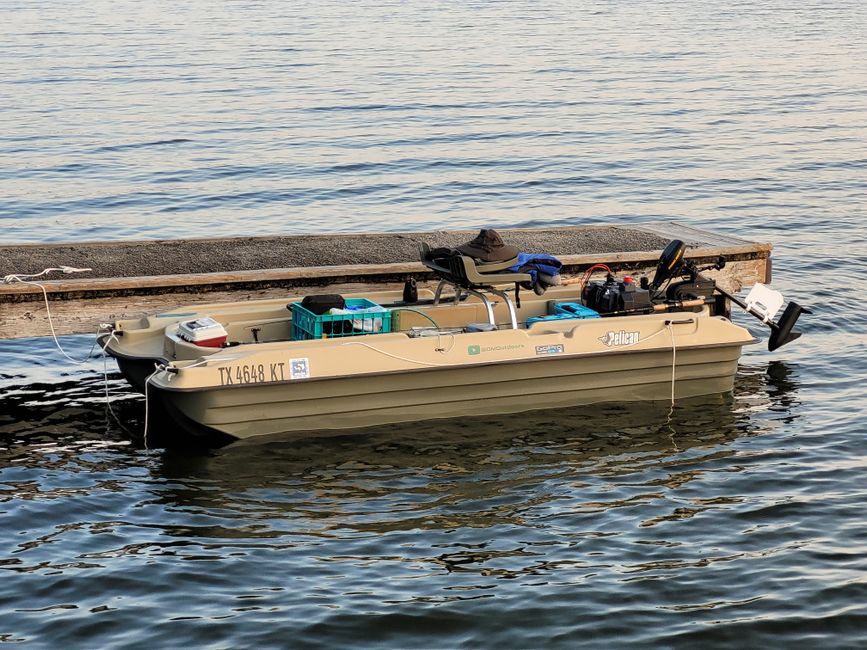
Choose a pontoon fishing boat by matching its layout to the water you use, the number of people who fish, and the gear that must stay aboard. A dedicated fishing layout gives more casting seats, storage, and fish-handling space. A Fish & Cruise layout keeps more lounge seating. Treat the capacity plate as a safety ceiling, not a promise of elbow room.
Space is the first catch. A boat can carry a stated number of people and still feel crowded once rods, tackle, coolers, batteries, and casting lanes arrive.
Bennington draws the layout line clearly. Its dedicated Fish layout has four fishing seats, a fish station, a livewell, and a midship L-bench. Its Fish & Cruise layout has two fishing seats, a fish station, a livewell, and a larger L-bench. The first serves the trip built around fishing. The second serves the trip built around fishing and passengers.
| Use pattern | Layout that fits | Tradeoff |
|---|---|---|
| Fishing is the main purpose | Dedicated fishing layout with more fishing seats and gear stations | Less lounge seating |
| Fishing and family cruising share the boat | Fish & Cruise layout with fewer fishing seats and a larger bench | Less dedicated casting and gear space |
| Heavier gear load | Layout with planned storage and balanced seating | Capacity remains a safety limit |
Choose the deck before choosing the extras. Rod holders, tackle storage, rod lockers, work stations, pedestal seats, and pro-angler stations are useful only when their placement leaves a clear path through the boat. A crowded deck turns equipment into clutter.
The U.S. Coast Guard says to know the boat's load capacity and designated passenger locations. It also warns that excess people or gear can make a boat unstable. Keep loads low, secure them, and spread weight fore and aft and side to side.
Federal capacity-plate rules do not settle every pontoon question. 33 CFR Part 183, Subpart C applies to monohull boats under 20 feet, with stated exclusions. A pontoon buyer should use the maker's own rating and capacity plate rather than assume that federal monohull rule supplies the answer.
Are pontoon boats good for fishing in rough water?
Pontoon boats are not a blanket answer for rough water; use the local marine forecast, the boat's rating, its load, and the operator's judgment before leaving shore. Stability at rest does not erase a weather warning.
The National Weather Service issues a Small Craft Advisory when wind or sea conditions can be hazardous to small craft. General advisory wind thresholds are sustained winds from 20 to 33 knots. Wave thresholds vary by region, from more than 4 feet on the central Great Lakes to more than 10 feet in western waters.
NOAA gives the reason no single number can clear a trip: vessel size, seaworthiness, and operator experience differ. Its guidance says, “There is no precise definition of a small craft.” Read the forecast for the exact lake, river mouth, or coastal area. Do not turn a broad label such as stable into a weather plan.
Water use should shape the purchase. A layout for sheltered lake days can give more floor space to fishing seats and a livewell. A boat used where conditions change needs an even stricter loading habit. Crest warns that forward trolling-motor and battery weight can require passengers and gear to shift aft for proper balance. Balance is not an accessory.
Do I need a livewell on a pontoon fishing boat?
You need a livewell when keeping catch or bait alive during the trip is part of the plan; otherwise, it is optional equipment that takes space and needs compatible plumbing. Buy the layout first, then the tank.
Bennington states that an aerated livewell keeps catch or bait alive because incoming water gains oxygen as it hits the tank's surface. Crest describes a related system using a below-waterline intake, pump, and spray bar to add oxygen for fish kept alive and healthy.
There is a limit hidden in the pump. Both makers say their livewell pumps work best at rest or at trolling speeds and do not draw water properly at faster speeds. A livewell is not a set-and-forget box while the boat runs fast across the lake.
A factory fishing package avoids a bad fit. Bennington advises buyers considering an add-on livewell to contact a dealer before installation. That guidance favors a layout already designed around the tank, its plumbing, and the storage lost to it.
Can I mount a trolling motor on a pontoon boat?
You can mount a trolling motor on a pontoon boat when the model and bow are set up for it, with the required gate, receptacle, harness, and separate battery. Confirm compatibility before buying the motor.
Bennington says a trolling motor is optional on select models and that bow mounting requires a trolling-motor gate. The boat can also require a factory- or dealer-installed harness. Crest likewise describes an optional bow-mounted electric trolling motor that plugs into a bow receptacle and runs from a separate deep-cycle marine battery.
The motor changes the load plan. Crest says the added forward weight of a trolling motor and battery can affect performance and calls for passenger and gear weight to move toward the back when needed. This is one reason capacity and comfort are different questions.
Use high platform and swivel seats for fishing at trolling speed, not as casual travel seats. Crest warns that occupants can be thrown overboard from those seats during acceleration or sharp turns above trolling speed. The best layout separates fishing positions from the places people occupy while underway.
Frequently Asked Questions
How many people can fish comfortably from a pontoon boat?
Comfortable fishing capacity is lower than the number on the boat's capacity plate. Count each angler, tackle, coolers, batteries, and the open floor space needed to cast before deciding. The Coast Guard says the safe carrying limit must never be exceeded, while Bennington's dedicated Fish layout shows the value of four fishing seats when angling space is the main job.
What is the difference between a fishing pontoon and a regular pontoon boat?
A fishing pontoon puts angling equipment and positions first: pedestal seats, livewell space, rod holders, tackle storage, rod lockers, work stations, and a trolling-motor gate are examples named by Bennington. A regular or convertible pontoon preserves more lounge seating. Bennington's Fish & Cruise layout illustrates the compromise with two fishing seats and a larger midship L-bench.
The plate marks the limit. The layout decides whether the day has room to fish.